
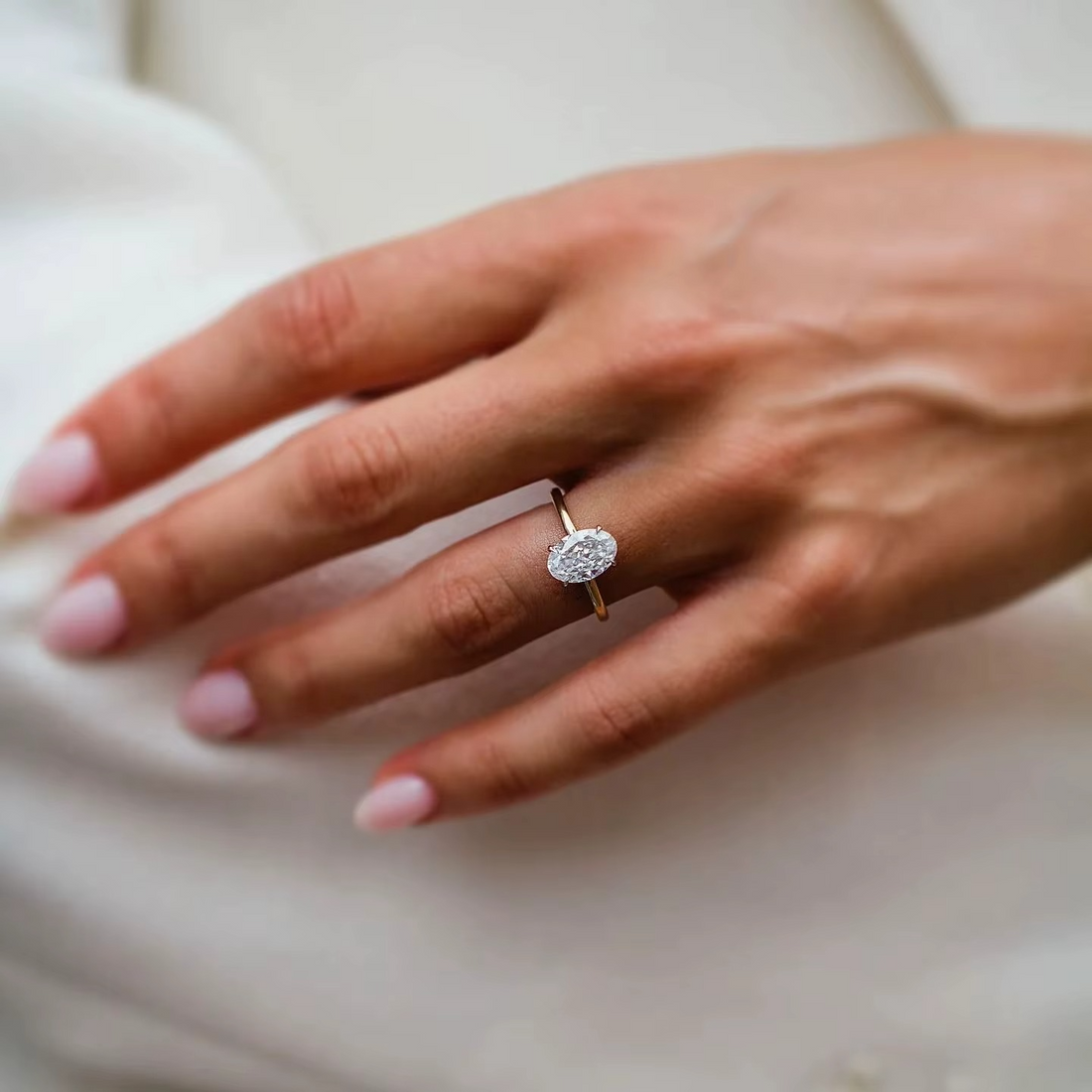
Moissanite vs Lab-Grown Diamond: Which Is Right for You?
It is the question we’re asked more than any other. Moissanite and lab-grown diamonds are the two stones at the heart of LM Jewellers, and both make breathtaking engagement rings. Neither is the “right” answer for everyone — so here is an honest comparison to help you decide.
What they are
Moissanite
Moissanite is silicon carbide, a gemstone first identified by the French chemist Henri Moissan in 1893 in fragments of a meteorite. Natural moissanite is extraordinarily rare, so the moissanite used in fine jewellery is created in a laboratory. It is not a diamond and not a diamond imitation in the old sense: it is a gemstone in its own right, with its own optical character.
Lab-grown diamond
A lab-grown diamond is a diamond: pure crystallised carbon with the same chemical, physical and optical properties as a mined diamond. It is grown using either HPHT (high pressure, high temperature) or CVD (chemical vapour deposition), and is graded on the same 4Cs. Without specialist equipment, even a gemmologist can’t tell it apart from a mined stone.
Side by side
| Moissanite | Lab-grown diamond | |
|---|---|---|
| Composition | Silicon carbide | Carbon (real diamond) |
| Hardness (Mohs) | 9.25 | 10 |
| Refractive index | 2.65–2.69 | 2.42 |
| Dispersion (“fire”) | 0.104 | 0.044 |
| Look | Bold, rainbow-flashing sparkle | Crisp white brilliance with balanced fire |
| Grading | Quality-graded by the maker | Independently graded, e.g. IGI |
| Value | The most sparkle for the least spend | A real diamond at a fraction of mined prices |
Sparkle: different, not better
Moissanite has a higher refractive index and more than twice the dispersion of diamond. In practice, that means more rainbow-coloured flashes — especially in sunlight and in larger stones. Some people adore that fire; others prefer the cleaner, whiter brilliance of a diamond. The best way to decide is to see both side by side, in daylight.
Durability: both made for daily wear
At 9.25 on the Mohs scale, moissanite is harder than every other gemstone apart from diamond. Both stones are more than durable enough for a lifetime of everyday wear in a well-made setting.
Value: where your budget goes
Moissanite typically costs a fraction of a lab-grown diamond of the same size, so you can choose a larger centre stone or put more into the metal and setting. A lab-grown diamond costs more than moissanite, but significantly less than a comparable mined diamond — and you can say, truthfully, that it is a diamond.
Choose moissanite for maximum fire and size. Choose a lab-grown diamond if the word “diamond” matters to you.
Ethics and origin
Both stones are created rather than mined, so neither comes with the environmental footprint or supply-chain questions associated with mining. Many of our couples choose either stone with this in mind.
Our honest advice
- Choose moissanite if you love bold sparkle, want a larger look for your budget, or prefer to invest more in a solid gold or platinum setting.
- Choose a lab-grown diamond if you want a real diamond with an independent IGI report, and the classic white brilliance that comes with it.
- Still undecided? Book a private consultation in Oakdene and see both on your own hand.